
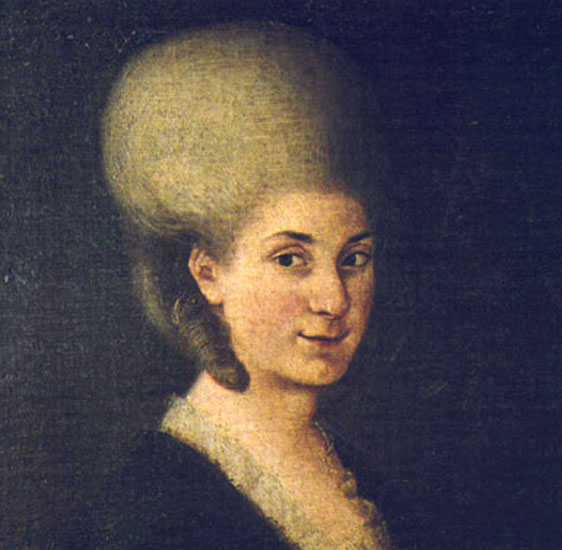
WOMEN'S HISTORY MONTH: CELEBRATING MOZART

Now I'm sure you're probably quite confused right now simply by the title. You must be thinking — Gee, I think this guy has finally lost it if he believes Mozart is a woman, though I assure you that I'm quite coherent. Let's address the elephant in the room. Now who exactly am I talking about? Keep in mind that Mozart is the famous composer's surname, which means that it's a possibility that I'm talking about someone related to him, and to which I would say you're right on the money. It kind of reminds me of how we tend to address Barack Obama as just Obama and sometimes we forget that it's actually his last name, quite the phenomenon. Anyways, asides my trivial ramblings, today we're going to celebrate the life and talent of Wolfgang Amadeus Mozart's older sister, Maria Anna Walburga Ignatia Mozart. (She was known as Nannerl for short).
I seems that musical talent is synonymous with the name Mozart and surely it ran in the family. Despite her relation to one of history's greatest composer, she held her own compared to her brother. Some experts argue that Nannerl was the most gifted and talented musician under the Mozart name, even more talented than Wolfgang himself. Not only was she masterful at the harpsichord akin to her younger brother but she was also a composer in her own right. There is a story where she sent a composition to her brother in 1770 and he responded with a letter stating, "My dead sister! I am in awe that you can compose so well, in a word, the song you wrote is beautiful." Essentially no sibling rivalry or bitter competition existed between the two Mozart children, and if anything Mozart was encouraging a supportive of his sister's accomplishments and endeavors. Together as a family along with their father Leopold, they toured Europe during the 18th century, making beautiful music together as a family. Now what more could you ask for?
You might be asking yourself that if she really was this much of a virtuoso, then why is she so seldom remembered when we talk about Mozart? I'd argue that Nannerl was unfortunately born too early, which caused her to be mostly forgotten in the pages of history. Remember that this is all taking place in the 1700s Europe, a place and time where equal rights between men and women unfortunately didn't exist. Specifically pertaining to female composers, only those of nobility were able to have their music exposed to the public. This is probably why much of Nannerl's work didn't survive up until today. It's said that Nannerl helped to write down Wolfgang's compositions when he was too young to do it himself, so its possible that some of those compositions are, in fact, hers. Furthermore, it was a time and place where if women were actually profiting off of their musicality, then they were deemed prostitutes, which just sounds utterly insulting but was the norm way back when. She was also hindered from growing as a musician when she was of marrying age by her father, who stopped bringing her on tour with them at that time. Despite that, she spent those years up until she was married composing, though as mentioned before, there's virtually no record of them today. I wonder why she was forced to stop when she became of marrying age, would men be too intimidated by a very talented and successful female? I hate the 1700s.
Now, if she were born in maybe the 20th or 21st century, I truly believe that her innate talent would be so much more appreciated by everyone and she would become a household name in the realm of composers and musicians. Though given all the different genres of music popular these days, it's also possible she would venture off into another type of music and gain popularity there. Could you imagine her with a guitar rocking out with a band? Who really knows, alternate timelines are confusing.
Regardless, another big reason why I believe she could've become more well known in a more recent time period is because there was no competition between her and Wolfgang. Because of that, they were able to grow as musicians together instead of butting heads and holding each other back. The reason she is not well known is in no part Wolfgang's fault, that burden rests on the bitter shoulders of history itself.
Many of those today who truly believe that Nannerl deserved more recognition have been making it a point of emphasis that she should be known. In 2010, a French filmmaker named René Féret produced a film called Mozart's Sister film, which attempted to show the life of Nannerl with speculations of what her early life could've looked like. Of course, that is really impossible to know because so little has been documented specifically about her life, though reviews claim the film to be very well-made. It does do an amazing job bringing Nannerl into the spotlight. The play initially hit venues across the world in 2015 and there probably aren't any showings anytime soon because of the pandemic, though I'm going to keep my eye out for it.
There is also a book by the same title, Mozart's Sister Book, which is appropriate for young readers as well.
It's truly a travesty that the stories of extraordinary women of the past in the book of history tend to be left unturned and subjected to erosion. Such is the case with Nannerl Mozart. It's refreshing to see recent attempts to recollect and remember her life's story. With the musicianship and pedigree of talent she possessed, she deserves recognition.